

Eggshell quality is one of the most direct yet often underestimated profit drivers in commercial layer production. According to industry data, Vietnam’s laying hen population reached 65–70 million in 2024, with total egg production expected to be around 20–21 billion eggs and 3–5% growth in 2025. Per capita egg consumption is estimated at 185–190 eggs per year. As flock density increases and laying cycles extend, problems such as high broken-egg rates, pale eggshell color, dirty eggs, and poor shell strength become more common. In many cases, the root cause is not simply a lack of calcium, but low absorption efficiency of trace minerals and impaired synthesis of the eggshell’s organic matrix.
Why Eggshell Quality Remains a Costly Challenge
- Low egg production rate
- High mortality and culling rate
- Poor egg quality
- High proportion of broken eggs
- High proportion of dirty eggs
- Pale eggshell color
Eggshell Structure: A Mineral-Dependent Matrix
The eggshell is composed of six layers from the inside out: the inner shell membrane, outer shell membrane, mammillary layer, palisade layer, vertical crystal layer, and cuticle membrane.
The palisade layer is made of calcium carbonate calcite crystals and is about three times as thick as the mammillary layer. It is the main load-bearing area of the eggshell.
The eggshell matrix also contains functional proteins such as: OCX-32, OCX-36, OC-116, OC-17, osteopontin, ovotransferrin, lysozyme, and ovalbumin.
-
IRON (Fe)supports protoporphyrin synthesis and eggshell pigment deposition.
-
ZINC (Zn)participates in the structural formation of calcium carbonate.
-
MNsupports the formation of mucopolysaccharide and keratan sulfate.
-
CU & MNare involved in lysyl oxidase and sulfhydryl oxidase (SOXs), affecting collagen synthesis and eggshell membrane cross-linking.
The Limitations of Conventional Inorganic Trace Minerals
The daily calcium requirement for laying hens is about 3.5–3.8 g per bird. When cracked eggs increase or eggshell color becomes pale, producers often focus on calcium. However, trace mineral status is equally important:

Inorganic trace minerals are prone to forming insoluble salts in the intestinal tract and can antagonize other minerals. As a result, even when the formula appears to meet zinc, manganese, and copper requirements, the actual amount absorbed and utilized by the hen may not be enough to support high-quality eggshell formation.
EggUltra Technology: Fully Chelated Small-Peptide Trace Minerals
Production Process
The production process first chelates elemental monomers with small molecules extracted from plant protein hydrolysis. After the chelation reaction, the chelated solutions are mixed and then spray-dried. The product uses an advanced pressure spray drying process with a fully enclosed system, self-control system, precise formulation, small error, precise nutrition, and full traceability. This ensures product safety, stability, and quality.
High Bioavailability
Because metal chelates are electrically neutral, they avoid the charge-based interactions that inorganic minerals undergo in the intestinal tract. This reduces resistance and deposition. The absorption rate of small-peptide chelated trace minerals can be 2–6 times higher than that of inorganic microelements.
Dual-Channel Absorption
EggUltra supports dual-channel absorption:
- Ion absorption pathway
- Small peptide absorption pathway
This allows faster absorption speed—25–40% faster than inorganic salts—and higher absorption efficiency.
Dual Nutrition Functions
The small-peptide chelate enters animal cells in an integral form and then disconnects the chelate bond inside the cell. It is decomposed into peptide and metal ion, both of which are used by the animal separately. This creates dual nutrition functions:
- ✔ Promotes protein synthesis in muscle tissue
- ✔ Supports intestinal health and flora structure
- ✔ Provides carbon skeleton and improves digestive enzyme activity
- ✔ Provides antioxidant stress and anti-inflammatory support
- ✔ Supports cell repair and metabolism
- ✔ Helps improve immunity and overall health
Lower Feed Nutrient Loss
In the small intestine, most protective elements of small-peptide microelement chelates are released. This helps avoid generating insoluble inorganic salts with other ions and relieves mineral antagonism. It also has synergistic effects with various nutrients, including vitamins.
Good Palatability
The product belongs to vegetable hydrolyzed protein, based on high-quality soybean, with a special fragrance that makes it more easily accepted by animals.
Application Validation
Case 1: Chengdu Feed Company Breeding Base
At a breeding base of a feed company in Chengdu, there were 30,000 Roman laying hens. In each ton of layer compound feed, 500 g of fully organic trace element premix containing EggUltra was added to improve eggshell quality. The results showed a significantly reduced breakage rate, improved eggshell color, hardness, and density, and extended shelf life of the company’s branded eggs.
Case 2: Mianyang Special Egg Chicken Farm
At a special egg chicken farm in Mianyang City, 3,200 black-feathered green-shelled egg chickens at 420 days of age were tested. By applying a 2.5% compound premix for the laying period containing EggUltra, eggshell quality improved significantly. Feces, feeding, and mental state of the flock were normal, and egg weight increased by 1–3 g.
Case 3: Santou County, Mianyang City
At a layer farm in Santou County, Mianyang City, 2,000 Jingfen No.2 laying hens at 375 days of age were used. The control group was fed a peak egg production compound feed from a certain brand. The experimental group was fed a layer compound feed processed according to the recommended formula of a 2.5% egg production period compound premix containing EggUltra. The trace elements used were a 0.2% layer trace element premix combining inorganic basic nutrition and organic functional packages.
- ✓ Broken eggs significantly decreased
- ✓ Eggshell color, hardness, and luster improved significantly
- ✓ Feces, feeding, and mental state were normal
- ✓ Compared with the control group, egg production rate in the control group decreased by 0.02%, while the experimental group increased by 0.22%
Recommended Application Plan
For layer feed, EggUltra is recommended at 300–500 g per ton. Formulation can also be optimized based on regional end-customer market positioning, breeding environment, nutritional level, raw materials, and eggshell quality.
Under non-antibiotic green farming, combining organic trace elements with microecological preparations, plant essential oils, acidifiers, and other additives can help maintain the poultry intestinal micro-environment, promote nutrient absorption and utilization, improve egg quality, enhance immunity, and ensure biosecurity. This is an inevitable trend in industry development.
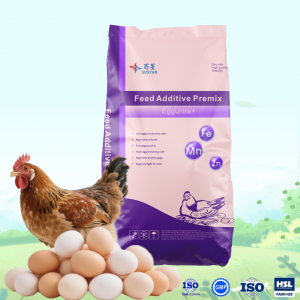
EggUltra+®
The layer complex premix provided by Sustar Company is a complete trace mineral premix, suitable for feeding layers.
About SUSTAR
SUSTAR is a manufacturer of feed additives serving the global animal nutrition industry. For product information, samples, or formulation support, please visit our website:

Free consultation
Request samples
Contact Us
Post time: Oct-13-2026


